Same call. Every surface.
Each blueprint runs through a different surface — MCP, CLI, REST, or the web platform — from a different runtime, for a different user.
Route
“Who approves this purchase?”
Route procurement approvals automatically
REST · n8n / your own backend · Ops engineer
Operational friction
Multi-million-dollar purchasing workflows stall the moment an AI agent has to figure out which manager owns sign-off for a given cost center. Org charts drift, group inboxes bounce, and the automation falls back to a human dispatcher — the exact bottleneck it was meant to remove.
How Roster resolves it
The workflow hits the Roster REST endpoint with a plain-language query. No routing table to maintain — Roster reads live directory metadata and returns the active owner.
POST /api/v1/resolve
Authorization: Bearer $ROSTER_API_KEY
Content-Type: application/json

{
  "query": "Who should approve a $240k purchase for cost center EMEA-Ops?",
  "project_id": "proj_procurement",
  "scope": "all",
  "mode": "live"
}
Business outcome
- Zero manual routing overrides.
- Purchase-order bottlenecks eliminated.
- Every approval fully auditable for compliance.
Sustain
“Who's covering while they're out?”
Find the acting owner during leave
MCP · Microsoft Copilot Studio · Project Owner
Operational friction
Contracts, approvals, and HR documents freeze indefinitely when the primary stakeholder goes on leave, changes teams, or leaves the company. Someone notices days later, then scrambles for a manual override.
How Roster resolves it
A document-approval agent in Copilot Studio calls the Roster MCP tool. Roster sees the primary is on leave and returns the delegate the Project Owner configured — no IT ticket, no central admin in the loop. The same call works from the OpenAI Agents SDK or Google ADK.
// MCP tool call
tool: resolve
{
  "query": "Who should approve this vendor contract in Legal Ops?",
  "project_id": "proj_legal_ops",
  "mode": "live"
}
→ primary "Daniel Roy" on leave
→ delegate "Priya Shah" · Legal Ops · active
Business outcome
- No missed contract deadlines.
- Continuous operational velocity through absence and reorgs.
- Business continuity that's automatic and compliant — not a fire drill.
Orchestrate
“Who handles this escalation right now?”
Escalate inside an agent fleet
MCP · LangGraph / CrewAI · SRE / platform engineer
Operational friction
A monitoring tool flags a high-severity anomaly. The autonomous response agent knows how to remediate but not who — or what — should own the next step at this hour. Paging the wrong on-call burns minutes and trust.
How Roster resolves it
The agent queries Roster over MCP mid-flight. Because Roster resolves three actor types — team members, AI agents, and service accounts — the next actor it returns can be another agent, not a person. The fleet routes itself; no human stitches the graph.
// MCP tool call
tool: resolve
{
  "query": "Who handles high-severity data-pipeline escalations right now?"
}
→ AI agent "Pipeline-Responder" (service account) · active
   (falls through to on-call human "Marc Aubin" if the agent is unavailable)
Business outcome
- Drastically lower mean time to resolution.
- No alert fatigue for off-duty staff.
- Agent-to-agent handoffs that work without a human in the middle.
Orchestrate
“Who owns sign-off for this service?”
Resolve at build time, ship it to production
CLI · Claude Code / Cursor / OpenAI Codex · FDE / developer
Operational friction
Developers wiring resolution into a pipeline don't want to spin up infrastructure or guess at an API shape just to test "who owns this?" And what they test by hand rarely matches what runs in CI.
How Roster resolves it
From the terminal — inside Claude Code, Cursor, or Codex — a developer runs `roster resolve` against a single local Docker container, then drops the identical call into CI. Sandbox to production, same surface, no rewrite.
$ roster resolve "Who owns release sign-off for the Payments service?"
→ Aisha Okafor · Release Manager · active

# same call, now a gate in the deploy pipeline
$ roster --profile ci resolve --project-id proj_payments --explain \
    "release sign-off"
Business outcome
- Resolution tested in the dev loop, not discovered in production.
- One Docker container — no database, no infra tax to evaluate.
- The same call from laptop to CI to runtime.
Trust
“Prove who decided, and why.”
Govern and observe every resolution
Web UI · Roster dashboard · Project Owner + Compliance
Operational friction
Decentralized routing is only enterprise-grade if you can see it. Regulated processes have to prove who was responsible at each step, which model answered, and what personal data was touched.
How Roster resolves it
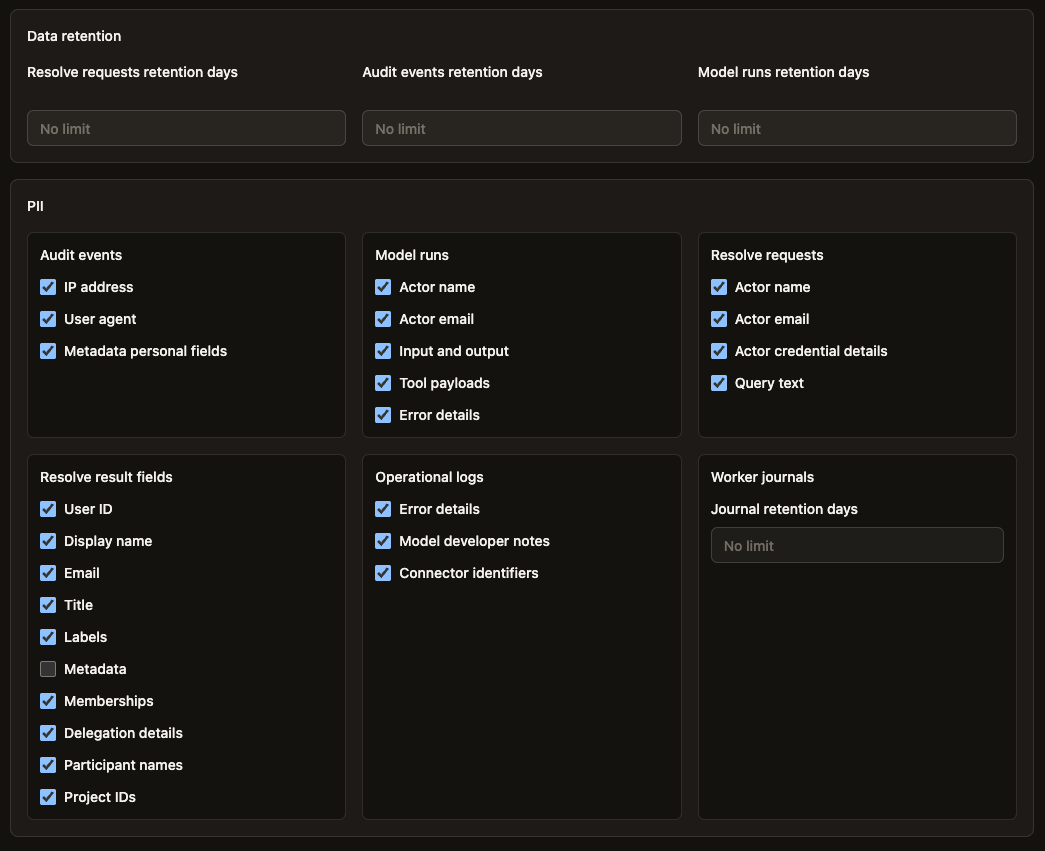
In the web platform, Project Owners manage the participants and delegations in their own projects — no central bottleneck. Whoever owns compliance gets an admin seat: the full append-only audit log, per-call model runs with token and cost detail, configurable data-retention windows, and field-by-field PII redaction. Directory sync keeps actors current from Entra ID, Okta, Google Workspace, Workday, LDAP, or CSV; scoped API keys gate every integration.
Business outcome
- A complete, explainable audit trail of who-acted-next, by design.
- Observability into every model decision — provider, model, tokens, cost — not a black box.
- Decentralized control with enterprise-grade governance — retention windows, field-level PII redaction, append-only audit, scoped keys.